Week 2 Reflections:
Hello everyone and welcome to another installment of...this
blog. Riveting stuff I know but the topics of this week have been rather
interesting to learn. We had a bit of a look at good pedagogical practices,
several teaching frameworks to help us along the way and an introduction to
wikis with a very useful activity involving coloured hats. So without further
delay I'd like to discuss a little question that's been nagging at me.
What defines good pedagogy? This is a question that every
new teacher is sure to ask at some point and the answers are just as complex as
you imagined. However the more I read about pedagogy, I find the same recurring
principles that can make the difference between positive learning outcomes and
negative ones. These principles start with KNOWING your students, and I mean
really know them, not just names but who they are as people. This allows you to
create content which is relevant to their interests and primary Discourse (I've been reading about literacy, I really
like the term Discourse), thus engaging the students interest in learning.
Finally as they are invested this allows you as the teacher to challenge them more
and encourage higher order thinking skills, thus maximising the learning
experience. Sounds easy right?
Anything can sound simple if you deconstruct it to base principles. But we are
talking about teenagers here, and a teenagers identity can flip with the change
of a hat (De Bono's joke) as they are at a point in their lives where they are
still figuring out who they are in relation to the world. Thus the knowing of
our students is an incredibly complex task, one that needs to be kept on top of
lest we lose their interest. Without this principle, the rest of the good
pedagogy process becomes extremely difficult.
As such, I've been thinking of teaching practices I might
employ to stay on top of this and I think I'd like to have a short constructivism
session at the beginning of every lesson. Whether this is a KWL on the new
material being presented, communal homework submission or just a general
Q&A, I think this will allow me to gauge the mood of the class before I
even begin and have an inkling as to how the lesson will go before I start. It
will also enable me to hopefully pick up any changes in students personalities
so I can better plan my lessons. If nothing else it encourages class
participation from the get go and will hopefully carry them through the
inevitable lecture component I just know I won't be able to avoid. Thoughts?
While you mull that over, I'm going to give my lecture on the teaching frameworks
we have learnt this week.
This week we were introduced to a couple of teaching
frameworks, the Blooms Taxonomy and the SAMR framework. These are two very
useful devices for teachers to create suitable assessment and learning
activities for the classroom. So let's take a look at them
 |
| retrieved https://wglink.pbworks.com/f/Bloom's%20Revised%20Triangle%20Color.jpg |
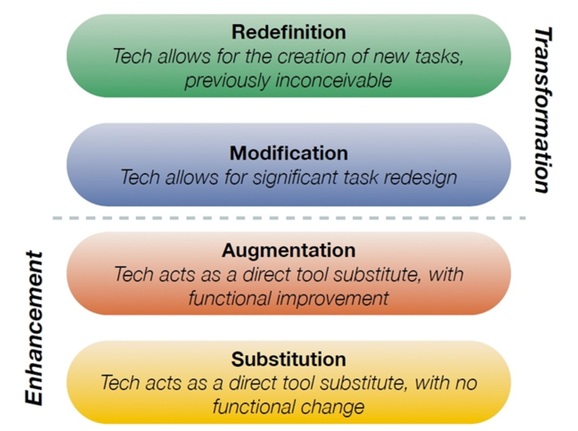
After this we look at the SAMR model for technological innovation. A bit simpler in its application, this model refers to ICT's and how their implementation by teachers enhances the learning experience. In this technology driven world it is assumed that using technology features in the classroom allow for a wider variety of teaching resources to be developed to aid in the learning experience.
 |
| retrieved http://www.schrockguide.net/uploads/3/9/2/2/392267/5805548.jpg?579 |
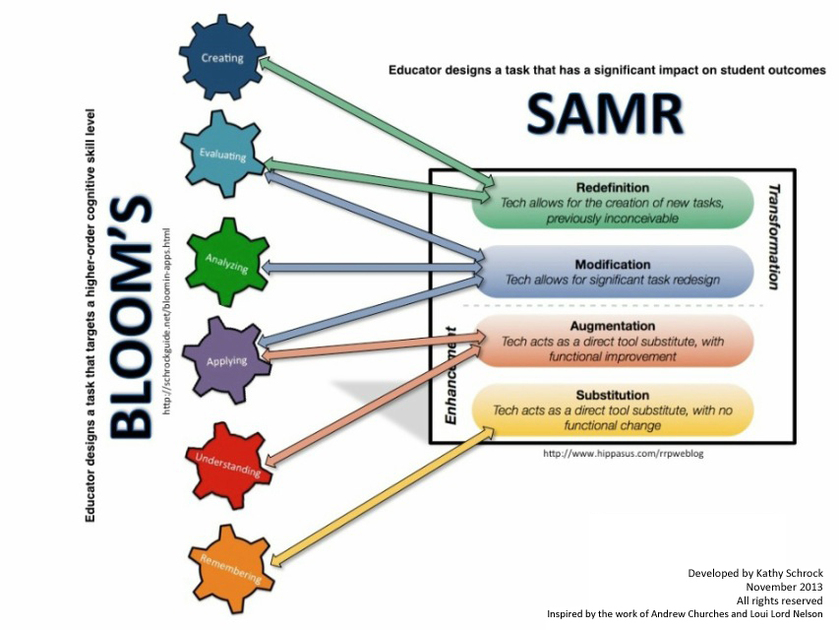
I'm beginning to notice a pattern in pedagogical concepts
and their love of tiered framework. This makes sense on reflection as it is the
goal of teachers to design good pedagogy that encourages higher order thinking,
which by its definition needs to build on lower order thinking. As such
correlations between the two frameworks explored this week can be made, and as
fortune would have it, is an almost direct link.
 |
| retrieved http://www.schrockguide.net/uploads/3/9/2/2/392267/8080832.jpg?841 |
Substitution and remembering are simple rote learning exercises much like behaviourism learning theory explored last week. Here you are simply copy/pasting onto a different format, maybe learning a little about the tech but ultimately just fluffing around. This covers projectors displaying the information so you save time writing on the board, while time efficient, does nothing for the students.
Augmentation, while still very simple, requires some limited understanding of the tool being used and the material being manipulated. This area covers manipulating the formatting and presentation of the material, applying your knowledge of the students so as to better engage them in the learning experience, and as such, applying a cognitivist learning method. Examples of this include power points, implementing videos or fun images to keep students interested.
The Modification phase of the SAMR model definitely requires analysis of the tool to make it function. The nature of the design of ICT's in the Modification tier means that their use is in application of knowledge. The example given in the video of the spreadsheet is an example of constructivism also, scaffolding and building on fellow students work to generate the suitable result. This also means there is a notion of evaluation at hand as the data entered needs to be assessed for relevance and consistency with the task or the program will not perform correctly (You ever divided by zero somewhere in a 2000+ point data spread...the whole thing bricks). Naturally examples of this included blogs or wikis that the students can engage in, communal activities like concept maps that can be modified and altered.
Finally Redefinition, being completely reliant on technology makes this the very definition of connectivism. As a teacher, using this technology means designing and evaluating things like an interactive webpage, games or online classrooms. I think pedagogies designed around this allows students to continue their own study outside of school time, perhaps due to the activities being homework assigned but I see it having very limited use inside of class time as connectivism effectively removes the teacher from the equation, and I just think that in class time can be better spent. Just my two cents on that one..
De Bonos thinking hats
No learning experience is complete without some form of
interactive activity with which we can apply our knowledge and trigger higher
order thinking. This week we participated in a wiki space utilizing the de Bono
thinking hats concept in an effort to tackle the contentious issue of mobile
phones in the classroom.
 |
| retrieved http://www.xasa.co.za/resources/Tools/images/6Hat.gif |
T
he concept itself, takes our understanding of a topic, makes us smash it into pieces then forces us into a higher tier of the bloom cognitive model by making us reassess our knowledge through six modes of thought process, demonstrated pictorially by six coloured hats. (see above) The method encourages lateral thinking in the student by getting them to analyse the topic through different methods, usually by asking a set of questions designed to encourage each particular thought process. This broadens the mindset and can often reveal aspects of the topic you never thought possible. For example with this mobile phone issue, I have always been a firm believer that mobile phones can lead to nothing but trouble in the class, overshadowing whatever so called advantage they can bring to the learning experience. But now I have the notion that it will probably happen anyway and I now gripe about what control measures need to be in place before it can be implemented. These thoughts had never occurred to me before.
We were given this task in the form of a wiki which we all
contribute to, and thus build a database of knowledge we can relate back to.
From this there were countless examples of those "so called"
advantages such as using the GPS feature mentioned by Johanna or using it for
scheduling, timetable changes (Leanne mentioned this) or if the parents
desperately need to contact the student. These out of the box suggestions haven't
swayed me to think mobiles in class are appropriate but they have widened my
perspective of how they can still be utilized outside of the classroom to the
benefit of the students. As such the wiki built upon the hats concept and
allowed for even further stretching of thoughts, not only thinking about the
topic from individual hats but expanding upon this with other peoples hats.
The overall process jumps up the Blooms taxonomy, going from
an application activity to an analysis one. The hats concept is a perfect example of
cognitivism at work, making students adopt the hats themselves and apply their
own thoughts makes them automatically relate it back to themselves, and thus
are already on the road to engagement in the activity. Most people will favour
one thought process naturally so getting them to adopt others triggers high
order thinking and empathy processes that they normally would not consider.
The wiki itself however, while a good demonstration of
social connectivism, can be at best described as a Augmentation SAMR process. This
only due to the need use different coloured text in order to distinguish your
own work, and that the many pages are conveniently located. Otherwise this
activity could very easily be done on paper with coloured pens. However the
obvious improvement this technology makes to the De Bonos hat concept shows that
even the lower order forms of tech can make a dramatic improvement to the
learning experience if implemented correctly.
References:
R. Henderson (2013) Teaching
Literacies in the middle years. (pp 139-140) South Melbourne, Victoria,
Oxford University Press
Krathwohl D.R.(2002)A revision of Bloom's taxonomy: An overview
THEORY INTO PRACTICEVol 41 Issue 4 pg212
Lisa Hogan
(2011) SAMR - A Model for Instructional
Technology Use. Youtube video

No comments:
Post a Comment